The story of the summer
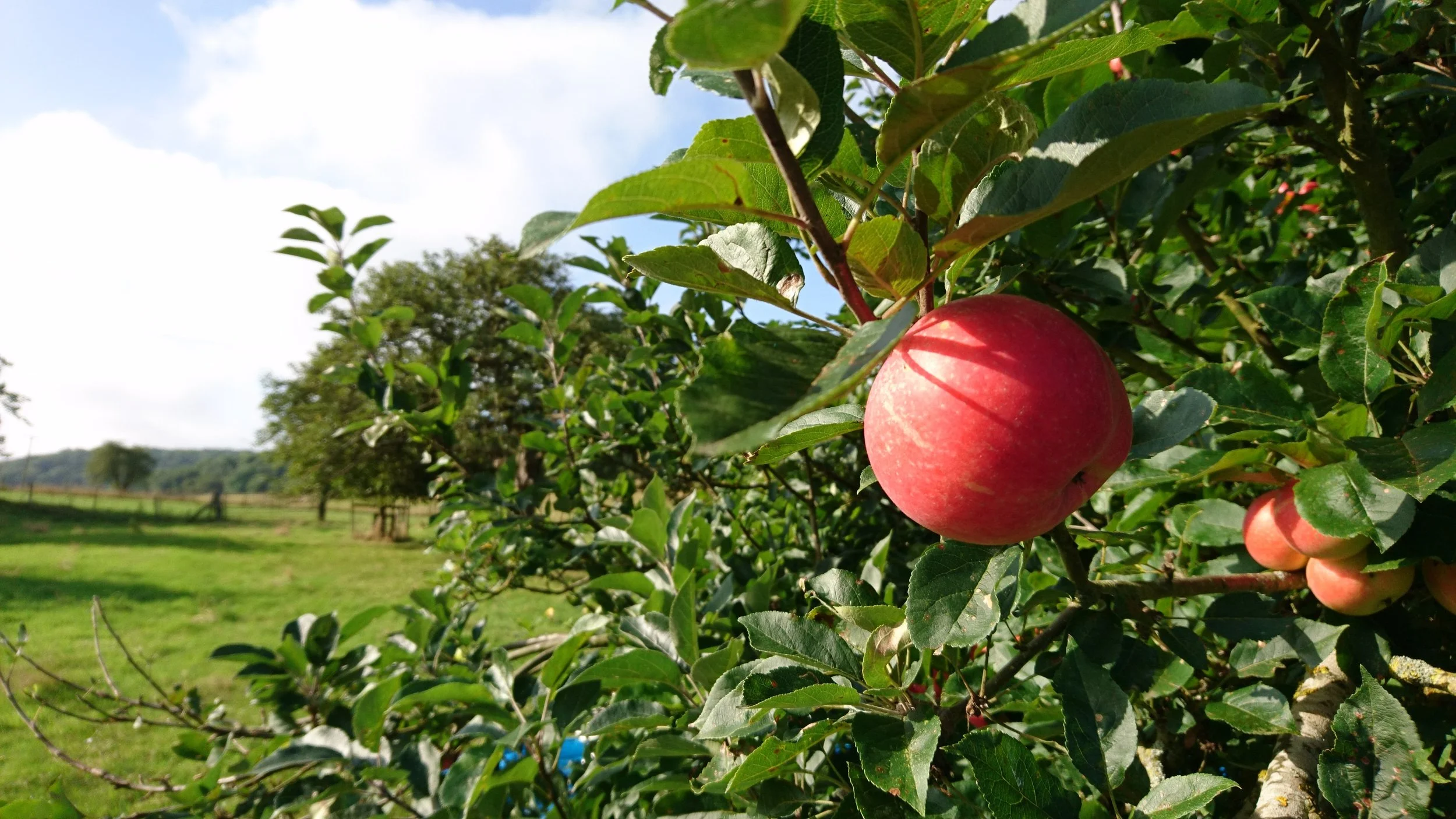
Discovery apples, a delicious early-season eating apple, whose parentage is Worcester Pearmain x Beauty of Bath. It was discovered in 1949 by George Dummer, a farmhand in Essex, and later developed and sold commercially by nurseryman Jack Matthews, from 1962.
We’ve picked our first apples of the 2026 harvest. Sunday 16th August, ridiculously early in the year. It was also a ridiculous day on which to start the harvest, the previous day being Cider Salon in Bristol, after which there was not just an after-party, but an after-party after-party and also an after-party after-party after-party, which meant we were not in the best shape, mentally or physically, to pick apples. That said, we just about got the job done and some delicious Discovery apples were milled and pressed on the Monday; Discovery fruit fades fast off the tree, so a degree of urgency is always required once picked.
We often say that the fruit tells the story of the summer. A hot, dry summer will produce small apples which will ripen early, will be very sweet but will be relatively dry, because the intense sunshine has turned all the starch in the apples into sugar (mostly fructose, some sucrose, a little bit of glucose), and given that an apple is 80-85% water, the lack of rainfall will result in small apples with low juice content. Conversely, a cool, wet summer will produce apples which will take longer to ripen, will be less sweet but be very juicy. That’s the narrative, reinforced by a selective memory and the anecdotes of fellow cider-makers.
Do statistics support the narrative? We’ve been picking Discovery apples from this orchard most years since 2018 and in a slightly nerdy way have compared information about the apples we picked with weather information from the Met Office to assess whether apples really do tell the story of the summer … and looking at our data the only conclusion one could draw is, absolutely, they do not!!! There appears, on the surface, to be little correlation at all.
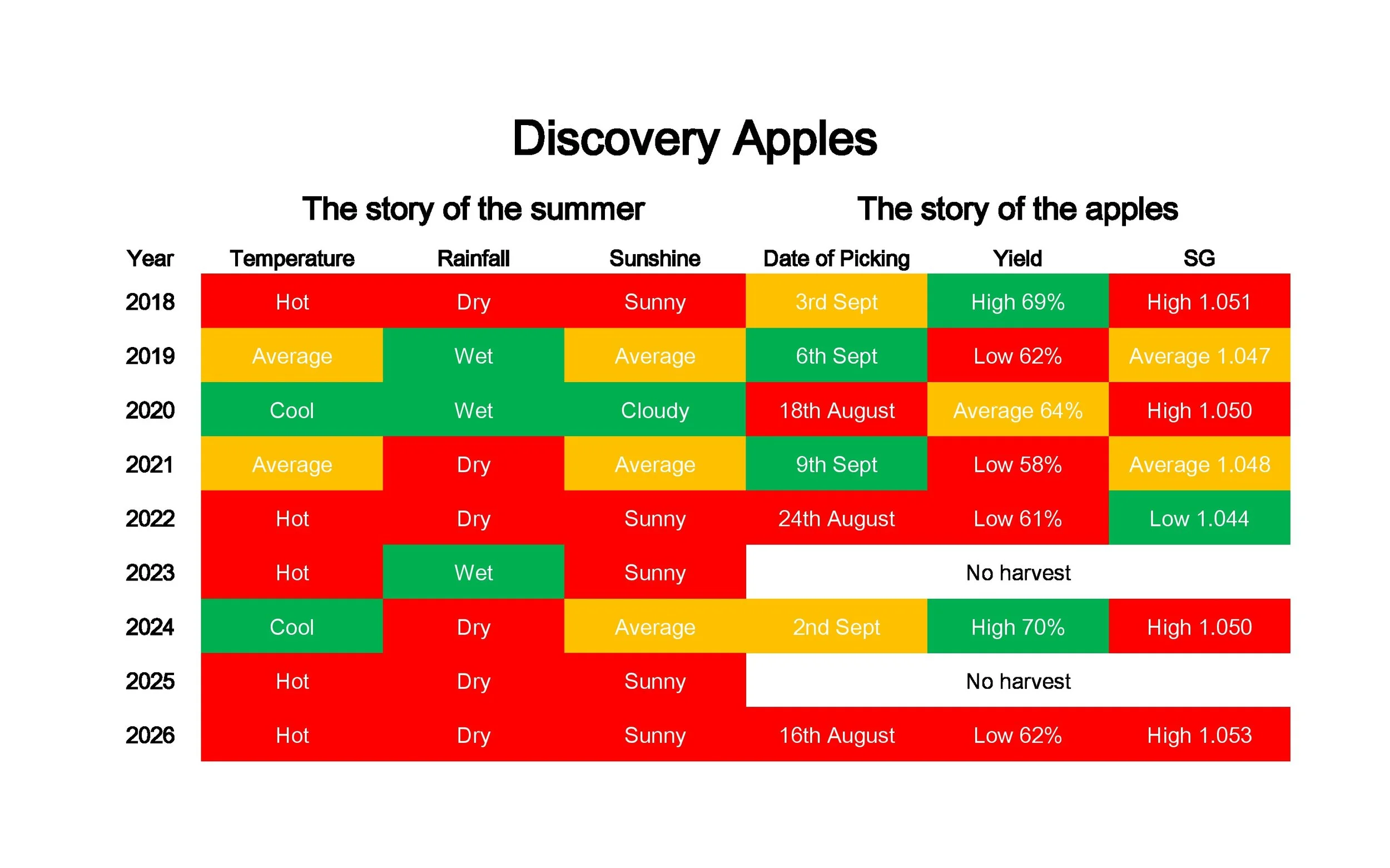
Comparison of weather information with the quality of apples: Met Office data comparing temperature, rainfall and hours of sunshine against 1991 to 2020 averages. Red cells represent years which were markedly hotter, drier or sunnier than the summer average, green cells show years which were notably cooler, wetter or more cloudy than the summer average, and orange cells show years which were broadly in line with summer averages.
Fruit picked before 25th August is early, picked after 5th September is late. Average Yield 63% to 67%. Average SG 1.046 to 1.049
The pattern is a mess or, more politely, there are anomalies aplenty. In 2018, the 2nd hottest summer on record, with lots of sunshine and little rain, the apples delivered an almost unheard of yield of 69% (we expect something in the region of 65% and are often disappointed), and we didn’t pick them particularly early. And in 2022, the 5th hottest summer on record, and with above average sunshine, the juice had a pathetically low SG of 1.044. Did photosynthesis not work that year? The only time we get a “proper” season is this year, 2026, when a hot, dry and sunny summer delivers the apples we expect - early, dry but sweet.
So what’s going on? Actually, stop reading now, this is quasi-pseudo-babble masquerading as science, it’s meaningless. Science is rigorous, science is precise, science is controlled, science understands what all the variables are, isolates them, controls them, measures them.
But that’s not the way we make cider. We make it naturally, instinctively. We know what’s important, we do take measurements, we keep proper records (if only to keep HMRC happy), but it’s not science, it’s anecdote.
The day on which we pick the fruit is based as much upon our mood and the availability of helping hands as it is on the ripeness of the fruit - and in one year on the availability of a vehicle, when a broken clutch meant Apple Wagon #1 needed to be replaced with Apple Wagon #2 rather rapidly.
Yields vary by how patient (or otherwise) we are; if we’re in a hurry, we release the press as soon as it has reached maximum pressure and the flow of juice from the pulp stops more or less immediately. On other occasions, we let it sit for 5 to 10 minutes, sometimes longer if it’s time for a break, and another 2 or 3 litres is released - that’s an extra 3 - 5% yield, quite enough to distort the picture.
And we don’t conduct iodine tests to measure how ripe the fruit really is; if Martin, with 40+ years experience of working with fruit trees, says the fruit is ready to pick, we begin to make arrangements to pick the fruit. Or, if Martin isn’t around, we check the state of the pips ourselves; if the pips are 100% black or dark brown, the fruit is ripe.
Apples on a tree don’t ripen all at the same time; the apples on the south- and west-facing sides get more sun and ripen earlier than those facing north and east. The apples hidden within the tree ripen later than those on the outside. With Discovery, there’s a 10 to 14 day period when the majority of apples on a tree are ripe, with other varieties it’s a lot longer. In some years (2020) we picked them “early ripe”, in other years (2018, 2019, 2021) we picked them “late ripe”.
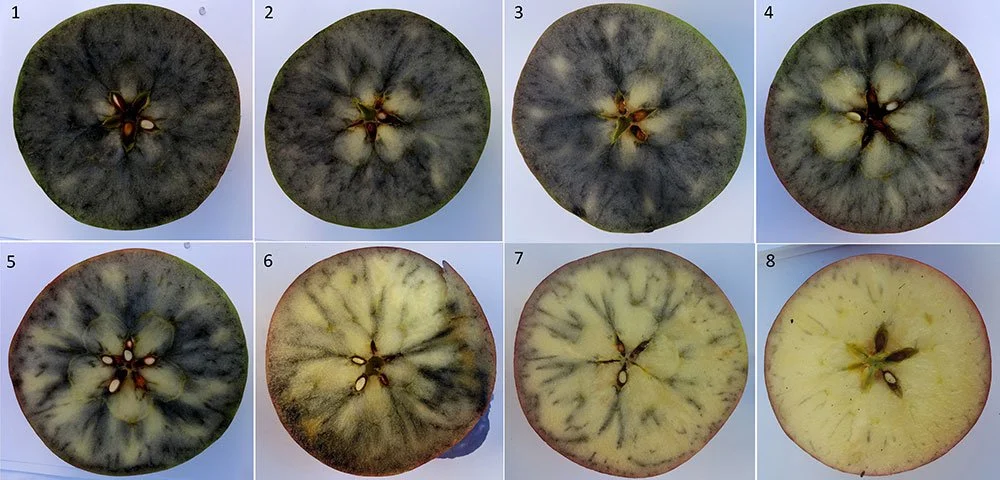
Iodine tests reveal the presence (dark purple) of starch, or its absence.
Of course apples tell the story of the summer, it’s the way nature works. So what’s the point of this piece? We live in a world where there’s as much misinformation as there is information, so it’s an encouragement to doubt, to check, to verify. Don’t buy this cider-maker’s narrative that the apples tell the story of the summer just because we say it, when we cannot supply any evidence to support the assertion (just buy his cider instead). In a similar vein, don’t buy joke politicians’ rhetoric that they have easy answers to the nation’s questions when they they really haven’t a clue; doubt, check, verify.
On a lighter note, our 2026 batch of Discovery apples is milled and pressed and fermenting away. If the warm weather continues it may have completed its fermentation journey by the end of the month, before we’d even picked the fruit in some years. It’ll have an ABV of 7% and we may do things slightly differently this year - a co-ferment, perhaps? We’ll keep you posted.
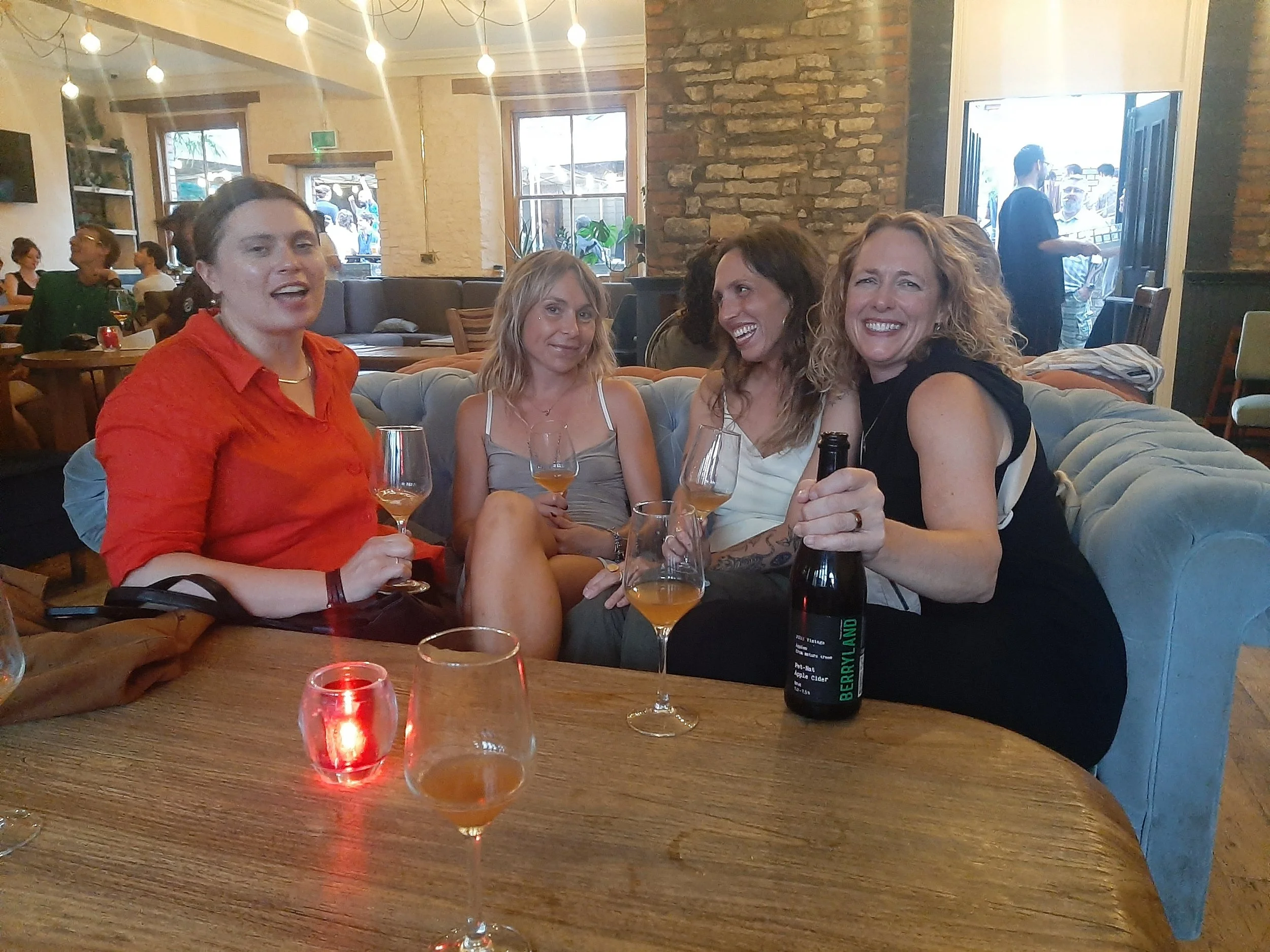
Proud and proper independent women, demonstrating that cider is a social drink, that pubs are social places and that Homo sapiens is a social species. From left to right: Aga (from the Fine Cider Company), Hannah Wallace (of Cider Salon and Bristol Cider Club fame), Meredith (friend of Christine’s), and Christine Bauman, cider-maker at Bauman’s Cider, Oregon, USA. They’re drinking Berryland Cider, made by Ukraine’s only cider-maker, whose cidery was destroyed by a Russian missile in 2020. It’s just one of the many ciders available at The Steam Crane.
The Official Cider Salon After Party
19:30 to 23:00, The Steam Crane, 4-6 North Street, Bristol BS3 1HT
The Unofficial Cider Salon After Party After Party
23:00 to 01:00, The Robert Fitzharding, 24 Cannon Street, Bristol BS3 1BN
The Unofficial Cider Salon After Party After Party After Party
01:00 to 04:30, The Steam Crane, 4-6 North Street, Bristol BS3 1HT
Since it would be a criminal offence for alcohol to be sold after hours, all alcohol consumed at the After Party After Party After Party was provided to revellers free-of-charge, thanks to the extreme generosity of the landlord, Steve, to whom we are very grateful. Steve has a HUGE range of ciders available in his pub, making The Steam Crane an essential stop on any tour of the best pubs in Bristol.