Nothing comes from Gloucestershire
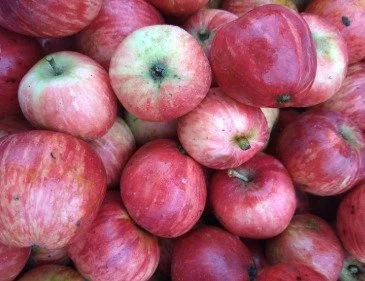
Foxwhelp: a Gloucestershire variety, although a fair few folk seem to think it comes from Herefordshire. They’re wrong.
Cider = Herefordshire.
Over half the cider drunk in the UK is made in the county of Herefordshire, so there really isn’t much room for argument. Herefordshire Cider has PGI status - Protected Geographical Indication - which means it’s a registered, protected food name under UK law, which guarantees the product’s origin and quality … well, origin, at least, because some pretty dreadful stuff is still made in industrial quantities in Herefordshire, PGI status or not (mentioning no names, contact us if you’d like our considered opinion).
Now, there are some folk in Somerset who may take issue with this opening statement, probably also some in Cornwall, Devon and Dorset, possibly also in Kent and Suffolk. But no one in their right mind would ever claim Cider = Gloucestershire.
In a similar vein, apples are grown in Kent and plums come from Worcestershire, from Pershore and the Vale of Evesham to be precise. Nothing comes from Gloucestershire.
And yet … once upon a time, long, long ago, when dragons roamed and Daenerys ruled the world, Gloucestershire was covered in orchards, and the county was a thriving centre for growing fruit, never the biggest but making a useful and valuable contribution to our pomological world. It has a history and tradition of fruit-growing that is worthy of record and recognition. One measure of this is the number of fruit varieties that come from Gloucestershire; the exact number is subject to some debate, but the latest count of apple cultivars from the county is 70, together with 22 varieties of plum and the county is also one of the homes of the perry pear, together with Herefordshire (of course), Worcestershire and Monmouthshire. An apple cultivar count of 70 probably isn’t the highest of any county in the land, but it’s a lot more than most.
But quantity isn’t everything, it’s the quality that counts, and amongst the 70 there are some absolute gems. Ashmead’s Kernel may be the finest easting apple on the planet. It may look a bit drab, mostly a rather plain russet, the rest - the side that gets the sun - a kaleidoscope of oranges and reds and golds, and the taste is simply exquisite, sometimes described as pear drop, possibly with a hint of elderflower, sweet but not overly so, the texture firm and crunchy; perfection.
Eden is another wonderful eating apple, but little known and difficult to find. It’s parentage is John Standish x Cox’s Orange Pippin, the former a gorgeous, bright red apple, the latter an apple that needs no introduction, so with that upbringing it’s not surprising it tastes delicious. It was first raised by E.J. Ingleby of Forest & Orchard Nurseries of Falfield in 1948, later distributed by Matthew Fruit Trees of Bury St. Edmunds, Suffolk. Quite why it never became more popular is a mystery. Fon’s Spring, raised and distributed in the same place by the same person at the same time as Eden, was thought to be the same apple for 50 years, until the advent of DNA testing revealed it to be a separate cultivar.
Lake’s Kernel is another wonderful eating apple, rare, unknown and unloved, as is Rhead’s Reinette, the latter dating back to c. 1900, raised by William Rhead at either Elton Farm, Elton, or Peglar’s Farm, Flaxley. Mr. Rhead eventually changed the spelling of his name, having become exasperated at it being misspelled by bureaucrats and administrators.
For cooking apples, look no further than Lemon Roy, an apple recently discovered by academics in England, France and Netherlands to be a parent to Edward VII, Green Harvey, Hormead Pearmain, Jubilee, Lombarts Calville, Longney Russet, Stanway Seedling and Wickham Green; given that Green Harvey dates back to 1813 and Hormead Pearmain to 1826, Lemon Roy is clearly an ancient variety.
As far as cider apples are concerned, Gloucestershire’s best known cider apple is Foxwhelp, a famously sharp apple now widely planted in Herefordshire and made famous by Herefordshire’s cider-makers, but is originally from the Forest of Dean, as first recorded in Ralph Austin’s fulsomely titled book, A Treatise on Fruit-trees, showing the manner of grafting, setting, pruning, and ordering of them in all respects(1653). Dymock Red is another ancient cider apple, first recorded in John Evelyn’s Pomona (1670), an apple much appreciated by the Long Ashton Research Station (before that establishment was disastrously abolished by Margaret Thatcher’s overly brutal cuts), where it was considered to be on a par with the celebrated Kingston Black. Single variety Kingston Black ciders can be found aplenty, not so for Dymock Red (although we do now have a small, 20 litre batch fermenting away). The absence of modern opinion pertains to almost all of Gloucestershire’s cider apples - Ansell, Brown French, Chaxhill Red, Fawkes’ Kernel, Gypsy Red, Hagloe Crab, Josey, Kempley Red, Kill-Boys, Longstalk, Old Tankard, Over Apple, Overleaf, Overton Red, Pear Box, Pedington Brandy, Red Styre, Reynold’s Crab, Upright Styre, Wick White Styre - possibly because there are not enough trees in existence to make a decent-sized batch or because the cider made from them was decidedly average and so the apple fell from grace. We don’t know.
And, if truth be told, amongst the 70 apple cultivars there are some absolute shockers. Our thoughts on the merits or otherwise of the Longney Russet will be the subject of a separate post, and even though we’d happily give it the award for the most useless apple in the world, we don’t wish extinction upon it. It represents a unique sequence of DNA, it may hold the secret to protect the Malus genus from some unknown pomological horror that may be around the corner. Also, tastes change, and it might just happen that its dry, granular texture, rather unpleasant aroma and its taste of bland nothingness will become fashionable in the future. Good or bad, all these cultivars need to be conserved - and the best way to do that is to plant them more widely.
A limited range of Gloucestershire’s fruit varieties has been available from local nurseries, in particular Walcot Organic Nursery and Lodge Farm Trees, both of which have been essential in enabling the Gloucestershire Orchard Trust to plant complete collections of the county’s apples and plums in their orchards at Longney. But in order to make a wider range of Gloucestershire’s apples available to the general public, we have collaborated with Walcot Organic over the past few years and now have most of the true Gloucestershire cultivars available for sale. If you’re thinking about planting a tree, or an orchard, then please click the button below to go to our Fruit Trees page for more information about how we may be able to help with the conservation of Gloucestershire’s apple heritage.